

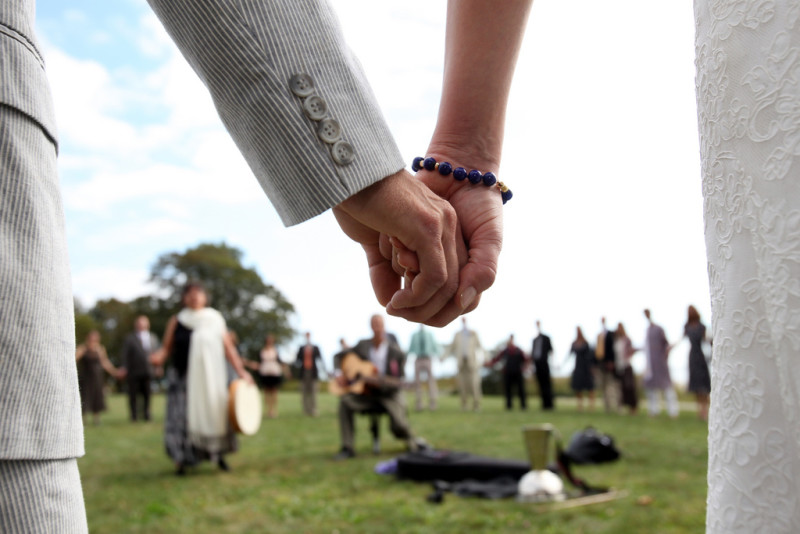


Modern Paganism is one of the world’s fastest growing religious bodies. In its simplest definition, Paganism is a modernized recreation of the indigenous spiritual traditions of Europe — basically, it’s a revival of the old pre-Christian beliefs and practices. However, this is the 21st century. Modern Paganism has been heavily influenced by modern values and ethics, such as feminism and environmentalism.
So please don’t fear that you may witness an animal sacrifice at a Pagan ritual; many of us are vegan and are strong supporters of animal rights!
But it might help to give you an overview on what to expect…so we prepared this guide! If you’re planning a pagan wedding, feel free to share this with friends or family members. And if you’ve been invited to a pagan wedding? Read on!
What is Paganism, anyway?
Related Reading
Should I tell my Christian grandmother about my Pagan wedding?
“I have a very close relationship with my Grandmother, however,… Read more
There is a wide array of religions and spiritual traditions that fall under the “Pagan umbrella,” and yes, some are legally recognized faiths. The main three religions you will find within Paganism are:
- Wicca: A nature-oriented faith that focuses on the cycle of the seasons. One of Wicca’s main tenets is the Rede, which is summarized as, “An it harm none, do as thou wilt.”
- Druidry: A recreation of ancient Celtic practices, with a strong focus on poetry and storytelling. An example of a Druid wisdom teaching would be this Celtic triad, “Three things loveable in a person: tranquility, wisdom, and kindness.”
- Asatru: A reconstruction of ancient Northern European beliefs. Think “Vikings” and you aren’t so far off. Asatru has the Nine Noble Virtues, three of which are courage, truth and honour.
What is a handfasting, exactly?
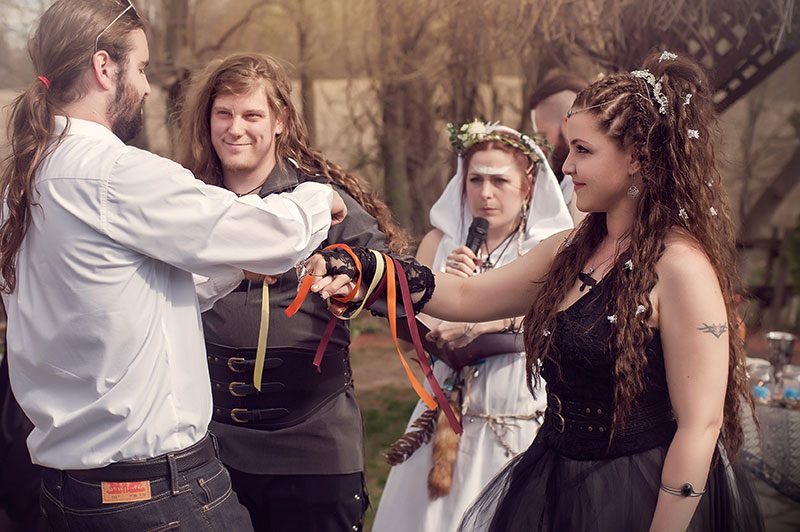
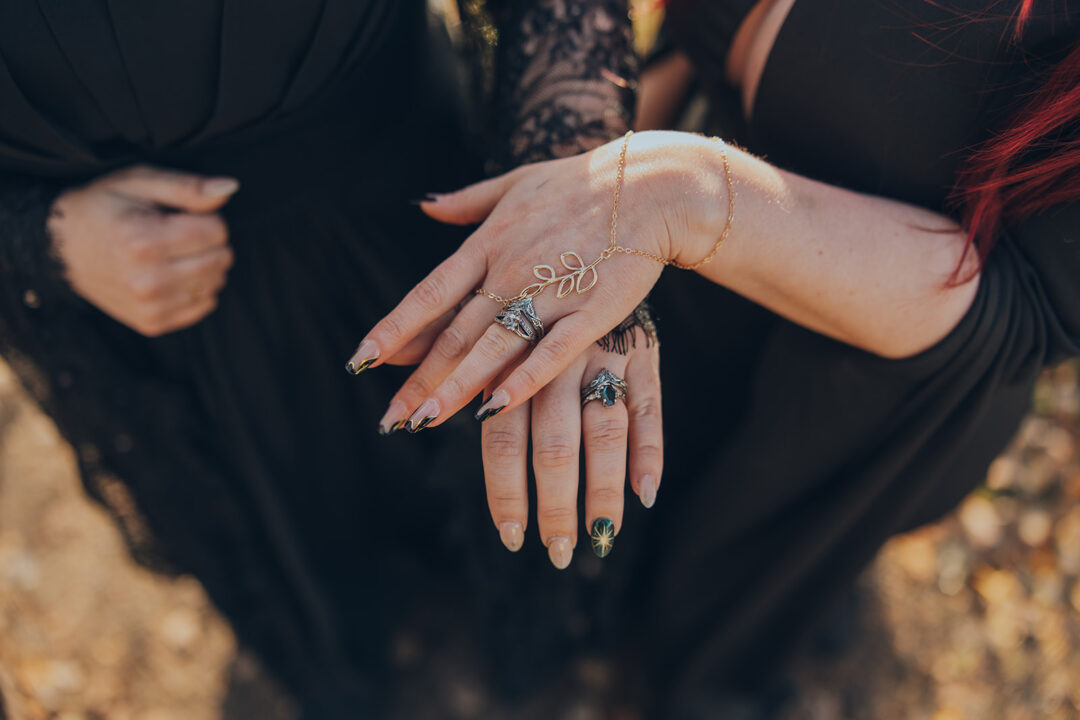
If you’re curious if handfasting is a pagan ceremony, the answer is yes. A handfasting is a wedding or betrothal ceremony, and to be handfasted is equivalent to being married or betrothed. Before we get into the details, let’s back up a bit and have a quick history lesson.
In most of pre-Christian Europe, weddings were fairly straightforward affairs, and this was especially true for northern Europe and Celtic lands. Two families came together and they worked out a deal on land ownership and any trading of goods. Then, the couple would exchange gifts, clasp hands, and make oaths of loyalty to each other.
Afterward their families and the community they lived in would throw a party and have a feast. Going to the trouble of a full religious ceremony officiated by a Druid (or someone similar) was typically reserved for people of very high social status. For most people the transition from single to married was a do-it-yourself affair, with the couple’s community acting as witnesses.
As Christianity began to spread across Europe, the new Church lacked the resources to have a clergyman in every rural village and hamlet. As such, the Church would send circuit priests to travel to out-of-the-way parishes during the warmer months.
Obviously, this presented a problem to families who needed to make an alliance with another family or clan. It’s also difficult to ask young people in love to wait so long before they can make a home together. Especially if the young woman was already pregnant!
Governments had a similar problem: it was too difficult to provide a judge or magistrate to every little village, let alone manage all the paperwork required for marriage licenses at a time when everything was handwritten on parchment.
So, the folk looked back to the traditions of their grandparents and found a compromise. The couple would self-marry in the old style when it was convenient for the community. The union would later be formally blessed by the church when the circuit priest came to visit.
In the Middle Ages, handfasting-type rituals became popularly used as betrothal rituals. In some parts of Europe, such as Scotland, the word “handfasting” was used to say that a couple was engaged. It was more common to hear that a couple was “handfasted” than “betrothed.”
Related Reading
Why I can’t gush enough about our color-coded handfasting ceremony
If you’re looking for a way to get your families… Read more
These types of self-uniting marriage traditions lasted well into the colonial era, when settlers in the New World faced difficulties due to long distances and lack of resources. It was only a couple of hundred years ago that nations began to pass legislation requiring couples to be legally wed via a specific set of rules. In fact, in some parts of the world, self-uniting ceremonies are still perfectly valid and legal.
As modern Paganism began to truly grow in the early-to-mid 20th century, Pagans sought marriage rituals that had historical significance without strong ties to other religions. Two fit the bill: the tying of hands in the handfasting tradition, and the jumping of the broom.

Are pagan weddings legal? Is a handfasting a real marriage or not?
A Pagan handfasting can be several things, depending on the couple’s wishes. It can be a legal marriage. It can be a commitment ceremony for a common law or civil union. It can be a kind of trial marriage for a couple who wish to ease into married life. It can be a formal betrothal.
The ceremony can be led by an officiant, Pagan clergy, a friend, or be a self uniting-ritual. Sometimes, due to the small size of our religious body, it can be difficult to find a clergy member who is also a legal officiant.
As such, Pagans who wish to become legally married will often “get legalled” before or after the wedding. They will have the legal paperwork and requirements taken care of at the local clerk’s office or another government-specified office.
What can I expect to see during a pagan wedding ceremony?
You may be surprised at how familiar much of the ceremony will be…
- There will be vows.
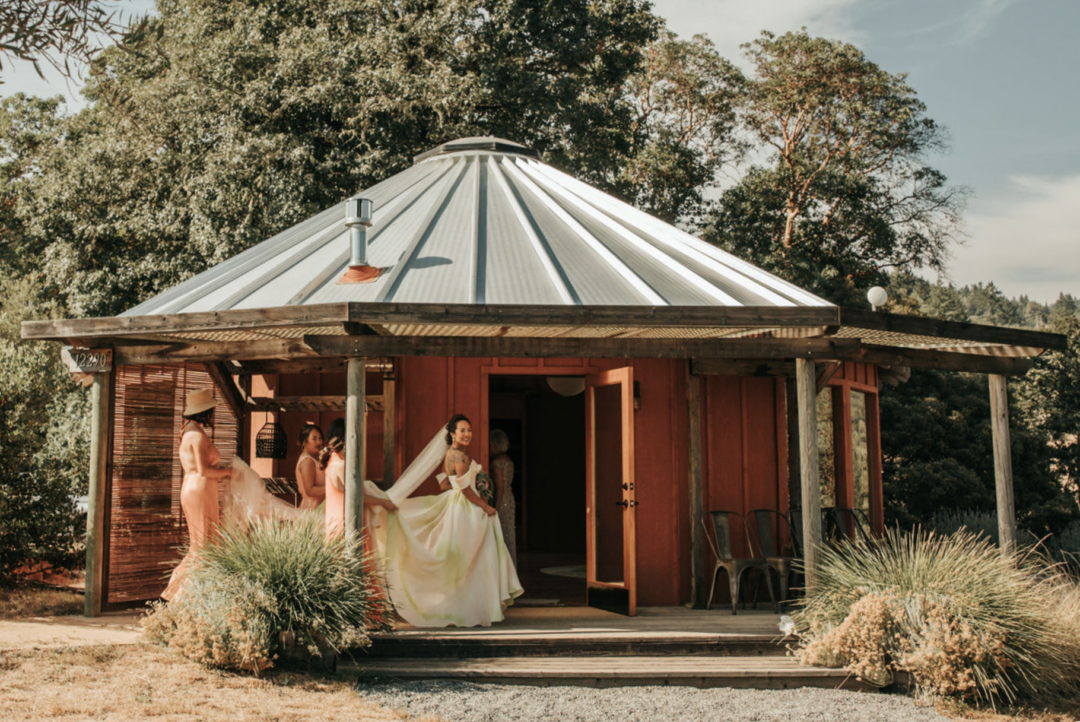
- You might see a bride in a white dress.
- You may see a wine blessing, or the sharing of a loving cup by the couple.
- You may see a bride wearing a veil; after all, this practice goes all the way back to ancient Pagan Rome, when brides wore brightly colored veils to protect themselves from evil spirits.
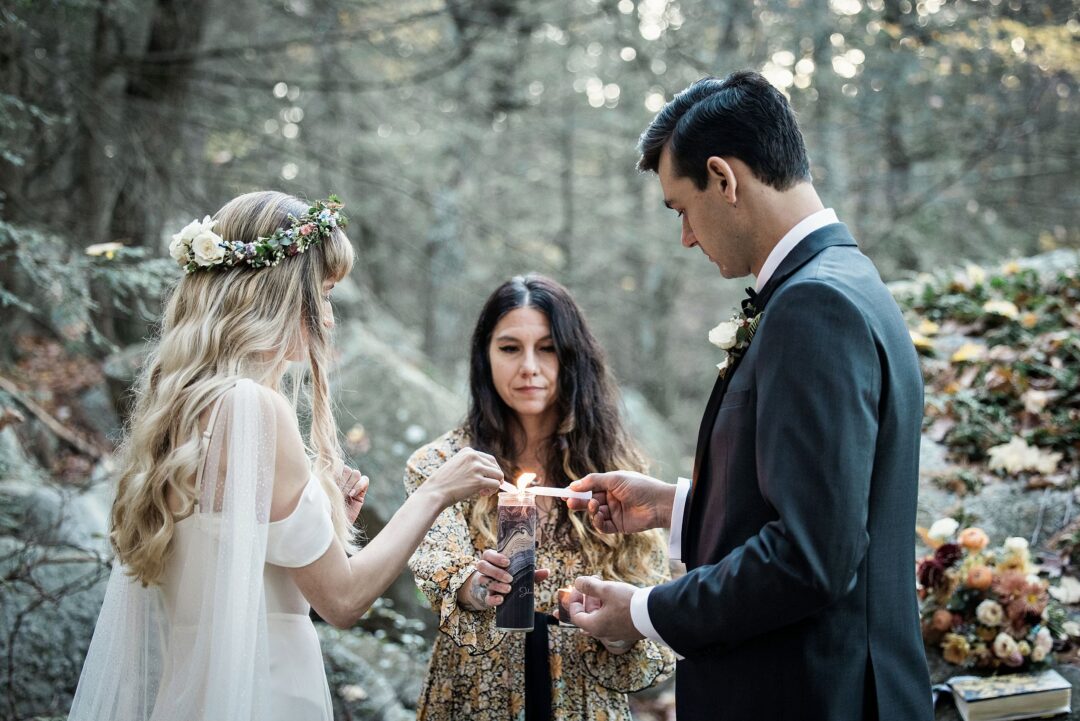
- You will probably see the couple exchanging rings or some other token of their love, such as necklaces. Rings and other jewelry have been used for the purpose of binding people to an oath since at least the Iron Age. You may see the lighting of candles, possibly even a unity candle ceremony.
What else should I be prepared for at a Pagan Wedding?

The officiant might be a woman, and a priestess at that. Even if this is not what you are used to, please treat her with the proper respect such a title deserves.
There is a good chance that among the guests and wedding party there will be people of every background. Expect to meet wonderful folks of many different gender identities, sexual orientations, races, social and economic backgrounds, and abilities. Equality, open mindedness, and inclusiveness are important values to Pagans.
Chances are good that the event will be held outdoors, so dress for the weather and leave your stiletto heels at home.
Please don’t worry about people running about naked. This is a wedding! While Pagans do have liberal and open views on the human body and sexuality, most people will NOT want to get naked in front of their grandmother at a wedding. This is one of those things that is made much of by media and Hollywood, but in reality is rather different.
Please do not handle or touch the wedding altar, any shrines, or any obvious sacred objects. Treat such things as you would an altar, shrine, or religious paraphernalia of any faith. Looking and admiring is perfectly acceptable. If you see folks lighting candles or making offerings (such as pouring wine into a dish) and you think that you may like to participate, simply ask what the etiquette is first. People will be happy to explain what they are doing, why they are doing it, and how you could too if you desire to do so.
If someone is obviously in prayer or meditation, please do not interrupt them.
Related Reading
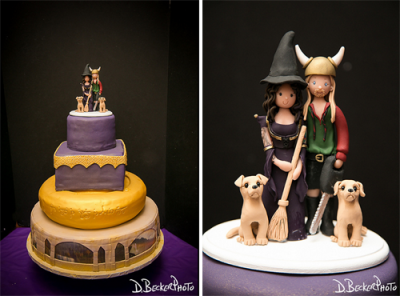
Mari-Anne & Larry’s big fat pagan handfasting
An enchanted forest theme, costumes, homemade mead, and a handfasting…… Read more
Please do not invoke or call upon any god(s) out loud without first asking if that is acceptable. It’s just good manners. Most Pagans are quite friendly towards other religions. Some may come from an abusive family or background of a certain faith, and not wish to hear prayers or invocation from that faith. You can pray with your internal voice as much as you wish, of course.
There is usually someone designated to mind any fires that are lit and to ensure that the wood for the evening’s fire doesn’t get used too quickly. Please ask before placing a log into a bonfire. If the “Fire Keeper” asks you to move a chair or do anything for safety reasons, do so immediately. Some fires are considered sacred as well, so do not throw any trash or cigarette butts into the fire until you know if that is acceptable or not.
Pagans love to give toasts. Expect a lot of them
Up next, PART 2 of our pagan wedding guide series:
Related Reading
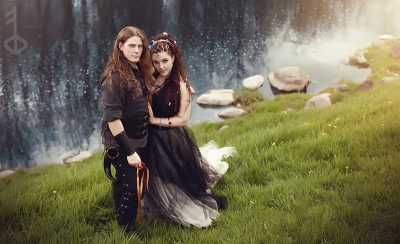
So you’ve been invited to a pagan wedding (Part 2 of our Pagan Wedding Guide)
Hooray! You’ve been invited to a pagan wedding! We’re so excited for you. That said, depending on your background or your beliefs, you might feel a little confused. What’s in store? Why is everyone standing in a circle? Are we… Read more




21 responses to “A guide to pagan weddings, Part 1: Everything you need to know, but were afraid to ask!”
Interesting. Where I live, I’d only heard of Asatru being a white-supremacist religion. This caused me to google and learn about other branches/factions of this pagan tradition.
White supremacist Asatru are an unfortunate and embarrassing minority. Like how the Westborro Baptist Church is to Christianity.
A lot of Norse Pagans use different terms for themselves for that very reason. Some of the ones I can think of off the top of my head: Heathenry, Northern Tradition, Norse Paganism, Norse Reconstructionism…
It’s to our shame that we do have some seriously gross historical and current issues with racism, sexism and the various other isms. But! That isn’t all of us and the majority of Heathens reject those sort of people and ways of thinking.
There is a growing movement on, for example, Tumblr, that is very diverse, positive and open, and very hot on actively working against and calling out both the more obvious and more subtle forms of bigotry.
It’s also worth noting that the racist, white-supremacist form of the faith is largely based in the USA – the more traditional groups in Scandinavia are much more awesome.
Then you don’t know much about european paganism. I mean….”negative energies”??? This is not chinese paganism. Paganism in Europe is more old-fashioned and less hippy-dippy tähän in US.
I love this, thanks so much for writing it! I think this post would be a good thing to send to family and friends beforehand or to link to on a website so people have an idea of what to expect.
Thank you for this post. I’ll be linking back to this in my wedding website. So much easier, and more encompassing, then anything I might write myself.
My husband and I are having a handfasting for our vow renewal is in 22 days and I have been looking for months for how to explain certain things to people and this post covered it all in one neat package. I will be sharing this with friends and family. Thanks so much for creating this post.
My wife and I are pagan. We had a Scottish medieval wedding. We called the quarters and invited the spirits to be with us. After the ceremony we had a great party. Love life and eachother.
It’s always great to see info put out there, for unfamiliar people to see. Handfastings are fantastic ceremonies, and the parties are even wilder. Although my wife and I are legally married, we cannot wait, to have our handfasting. Crossing it with a “My Little Pony: Friendship Is Magic” theme will be interesting, though. (My wife loves Cadence and Pinkie Pie lol.)
In my research for Hand-fasting and Celtic wedding rituals, I found that jumping a broom and a sword or knife was practice. I think you might make an ‘x’ and jump over them both
Paganism isn’t just about European religions.
In fact, it consists of all Non-Abrahamic religions INCLUDING those of America, Africa, and Asia, etc.
Buddhism, Hinduism, Vodou, Hoodoo, the list goes on.
Fascinating and very informative, thank you for this comprehensive explanation.
The section about jumping the broom caught my attention due to the mention of the wedding broom having the old timey wimey name of Besom.
I live maybe 20 minutes away from a place called Besom Hill. So im guessing it could have something to do with things like this? it certainly looks the part lol.
https://ukfossils.co.uk/2013/03/17/besom-hill/
My Beloved is leaving all the wedding stuff to me. Since I am a pagan, I’m hoping to have a pagan ceremony. He seems cool with it. What worries me most is his very Catholic grandmother – a very strong and wonderful lady whom I respect very much. I’ll keep this article in mind when I talk to her about it. Thanks for this!
Hey, I’m also pagan and my fiance is indifferent. We both have family who is Christian though. A good book for you to look into is Handfasting: A Pagan Guide to commitment rituals. It has an awesome interfaith ceremony in it that works well when guests are Christian 🙂 Hope that helps you!
Thank you for this article! I incorporated many Pagan practises in my own Wedding, but didn’t tell anyone except my husband what I was doing. I am Pagan and my Husband is Atheist. His entire family is Christian to varying degrees from “sure I’m Christian, but don’t go to church” to “You are a Satan worshiper if you so much as burn incense”. It’s ‘fun’……. I don’t have family, but my friends are born-again Christian. Those few that I’ve told of my beliefs actively forget them and tolerate me by pretending I never said anything and so must be Christian too…..because “isn’t everyone?”……I explain this because letting people in on what I wanted and why for my wedding was not going to go well and I don’t like drama. That didn’t stop me from doing an alter and wine offering anyway though! 🙂 No one cared enough to ask and I didn’t feel the need to tell – it was for me, my husband and the spirits anyway. 🙂
A lot of folk are so ignorant (and I mean this in a kind, awareness way) of other religions and customs that they don’t realize what is happening when some ritual is a little different is slipped into the ceremony. Do what ye will…..etc
This is such a lovely article! The handfasting ritual is so beautiful. I admire the way this article is written, thank you for sharing it with the world. Blessed Be.
This is wonderful!! I look forward to my own Pagan wedding! Thank you!
Great Article, done a few of these myself, thanks for sharing