


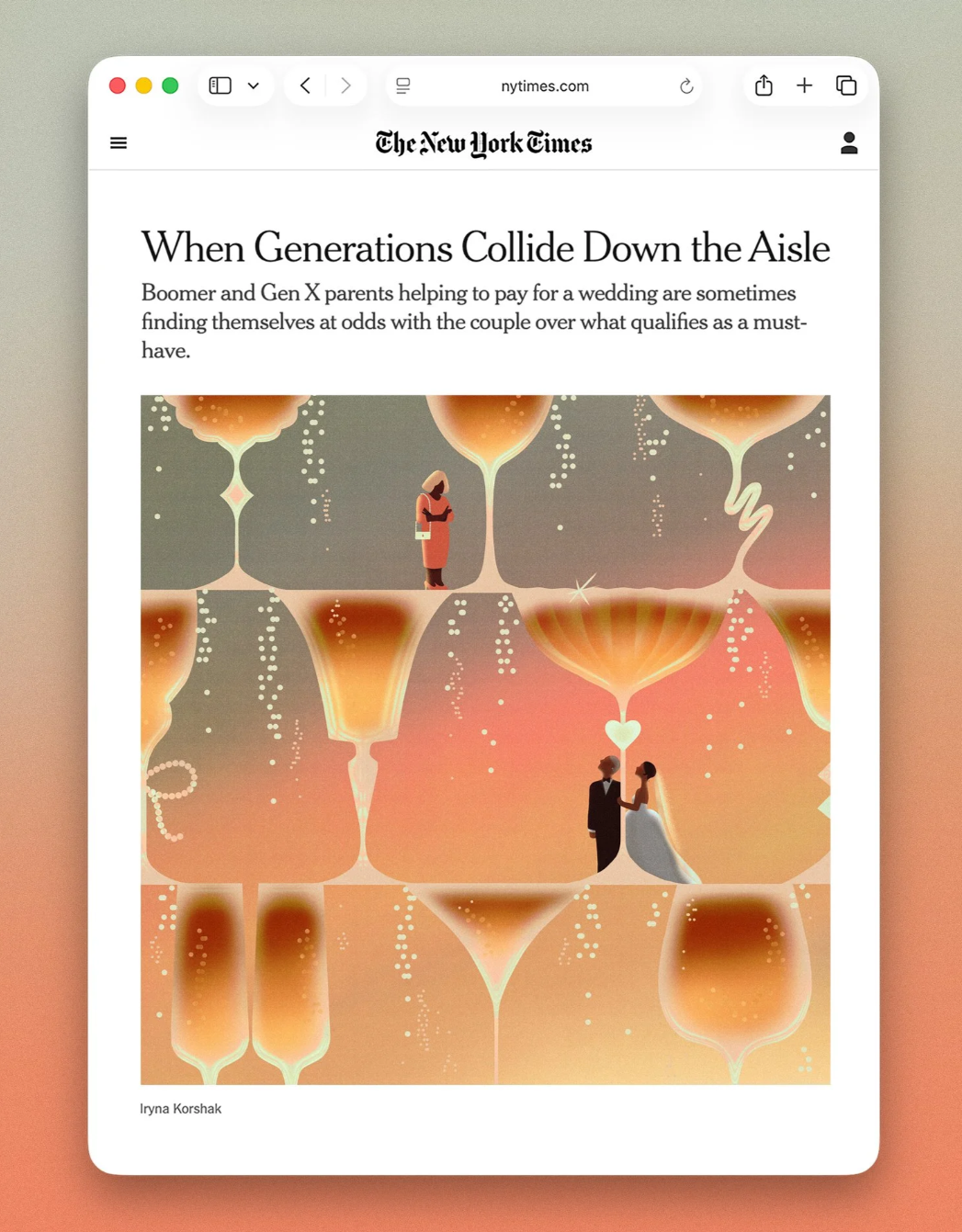
The New York Times published a piece this week about intergenerational wedding conflict, specifically the friction between couples who want something personal and parents who are paying for something “timeless.”

Reporter Tammy LaGorce called me because I’ve spent two decades watching this exact dynamic play out in real time… since Gen X were 20somethings getting married (and now we’re the parents of the newlyweds!). Not only did the article quote me, but it also featured Ohio wedding planner Emily Berg, a member of our vendor community. (This is the second time this year vendor members have been quoted in the Times… love that!!)
The article is great, but it didn’t get into some of the structural issues underneath the dynamic, and that’s the part that might be useful for vendors to understand.
The wedding industrial complex has been marketing to parents all along
Here’s what doesn’t get said enough: the mainstream wedding industry is not, primarily, marketing to the couple… It’s marketing to their parents.
Parents who are writing checks are far more susceptible to industry messaging about what a wedding is supposed to look like. They grew up with a different relationship to media authority. When a venue-mandated coordinator or a traditional florist says YOU NEED THIS, a lot of parents internalize that as fact in a way that their kids (who’ve spent years swimming in contradictory internet opinions) simply don’t.
What follows is this very specific kind of conflict that might LOOK like it’s about table settings or guest lists, but is actually parents enforcing commercial traditions the couple themselves don’t recognize as mandatory (because the industry spent decades telling parents those things were non-negotiable!). I’ve called some of that mainstream wedding marketing messaging predatory before, and I stand by it.
Why it explodes at the same time in every family
I’ve described weddings as a petri dish of family dynamics for decades. All the stuff that’s been simmering, how a family handles money, whether they treat adult children as actual adults, how they navigate disagreement… it all gets concentrated into one high-stakes event with a deadline, a budget, a guest list, and everyone’s feelings turned up LOUD.
For some couples in their 20s, wedding planning is the first time they’re negotiating with their parents as a fellow adult about something with real financial and emotional weight. Many families don’t have the communication infrastructure for that conversation, so it can get ugly fast, and in ways that are remarkably predictable once you’ve seen it enough times.
This is useful to understand not just as cultural context, but as practical information for how nontraditional vendors might work with their clients. When a couple comes to you stressed about a parental conflict, they’re usually not dealing with a taste disagreement but rather a power negotiation their family has never had before with a wedding as the arena. Knowing that can shift how you listen, how you ask questions, and how much you can actually help.
Why the New York Times keeps calling

I’ve been publishing Offbeat Wed since 2007, and reporters who cover weddings, relationships, or family dynamics know this is the home for more nuanced thinking about weddings. So, when Tammy needed a source who could talk about the long view on this particular dynamic, she called me. And when she needed to talk to vendors who could report on the issue from the trenches, I referred her to several of the folks whose work and thinking I know well because they’re an active part of Offbeat Wed’s community.