



Offbeat Wed Vendor Memberships include 1:1 consulting calls with the founder of Offbeat Wed — that’s me, Ariel! I’m working with 120 vendor clients this year, and every call starts with whatever question they bring. I’ve noticed that some questions repeat.
Here are the questions I hear most, what I do about them on the call, and some anonymized examples. You may recognize your own business challenges in a few of them: marketing shifts, AI anxiety, visibility challenges, impending burnout, and big ideas that need some support.
Common wedding vendor struggles, and what I do about it
“How do couples even find vendors now? Do directory listings still work?”
Most calls start here. Couples used to find vendors by browsing blogs and directories, social media, or googling. Now a lot of them ask ChatGPT, Gemini or Google’s AI summary, and those tools answer by repeating what trusted sites say about you.
Many of my calls start with what a directory listing even does in 2026: while listings used to be advertisements, now they act more as reference pages that teach humans and bots what you do, where you work, who you’re best for and when to recommend you.
I teach my vendor clients that LLMs train on trusted, high-authority sites like Offbeat Wed, which means a well-written directory listing literally puts words in the bots’ mouths: the specific language you use in your online listings is the language AI reproduces when describing you. The practical work is FAQ-style content, entity clarity, plain-language identifiers in headers, and consistent naming across every surface. There are millions of LLM bots training off of the text on Offbeat Wed every day, and so what you teach them about your business on your listing can determine who chatbots talk about you to prospective clients.
My faveorite example:
If your listing says you’d love to photograph a wedding with a goat ring bearer, and then a goat farmer two counties over asks ChatGPT for a photographer, you may be the only one the bot has ever seen talk about goats. It’s more likely that you’ll get recommended. The more deeply specific and high niche you can get in your vendor listing, the more likely it is that your niche clients can find you!
“AI is changing the game, and I don’t understand it. (Also, I might hate it.)”
Many vendors are operating on SEO advice from the Obama era and Instagram assumptions from before the pandemic. Meanwhile, their prospective clients are talking to ChatGPT and Claude about their weddings, and getting vendor recommendations from Google AI search results.
Some of my vendor clients love AI, while some refuse to use it on principle… as a wedding vendor, regardless of whether you’re choosing to use AI for your business, you must understand how potential clients are using it.
I separate AI discoverability from AI endorsement. I teach my vendor clients that YOU don’t have to use AI, but your business must be findable by the tools your clients are using, which includes AI.
A few examples:
- A nerdy wedding planning team is ethically opposed to using AI, which I told them is a valid position that changes nothing about the fact that their couples may be asking AI “who can help me with my Star Wars wedding?” We talked about using an FAQ to exactly those questions so the bots could quote them (all with no AI use required on their side).
- An alternative photographer in the UK had been running their copy through AI for a year, and I did the opposite work: flagged the AI-smoothed phrasing that had sanded the specificity out of their voice, and taught them the tells so their sharpest, earned lines could do the positioning.
“Why do I sound like everyone else?”
“Authentic.” “Candid.” “Capturing moments that matter.” I call this wallpaper language: phrases this common do zero filtering, and they force potential clients to do interpretive labor most of them won’t bother with.
I audit my client’s websites and listings and flag any sentence that could appear unchanged on a competitor’s site. Then we replace vague or emotional claims with observable behavior: how you start with a client, and what you do when things get confusing. Think of this as specificity surgery!
I also push vendors to name their clients’ actual fears out loud, because no one is googling “Authentic wedding photographer.” They’re googling “How to not feel feel awkward on your wedding day,” or talking to a chatbot about “What if my wedding feels like a staged photoshoot?” The vendor who names the uncomfortable thing directly can win the booking.
example:
- A photographer in New England kept promising clients would “feel seen,” but never explained what she does differently to make that happen. We converted her vague feelings-language into the specifics of how she shows up on weddings days, and what she does to validate her clients in the moment.

“How do I get more of these clients?”
You know exactly who you want: queer couples, elopements, introverts, anime nerds. Your website hints at them and never names them. Bots can’t read identity off your photos, so we write it down. That includes who you’re not for, and it can feel awful to name those things when inclusion is your whole value system. A filter is how the right people know they’re safe.
I also work with my clients to move their inclusivity from adjectives to practices. Don’t just say “love is love,” tell clients about your gender-neutral contracts, the pronoun field on your intake form, or the quiet room at the reception. And for the neuro-spicy Gen Z babies, I teach my clients to talk them through their booking processes. If they have to guess, they may skip you.
Vendor listings are a great place the place to practice this. While 60k people a month are reading, there are millions of bots scraping every last word, so be you can be braver in a listing than you might be on your homepage. Write FAQs for the clients you want next, including ones you haven’t met yet: “Have you done a Pokémon wedding? Not yet, and I’m dying to get a yellow dress down the aisle.”
real life examples:
- A photographer who’s loud about her politics on Instagram realized her website was the toned-down version, and lit up at the idea of saying she won’t shoot ICE agent weddings.
- A farm venue wanted more queer couples. Its events manager had written a welcome statement naming what rural queer couples worry about (is there a MAGA flag down the road?), and it was buried at the bottom of the listing. We moved it to the top and mapped where else to show up, from the farmers market table to local Pride.
The story you haven’t told yet
My favorite moment on a lot of calls is finding the thing a client left off their website because it seemed irrelevant, too personal, too weird, or like a liability. I’ve spent 20 years as an editor sniffing out stories, and a surprising number of vendors are sitting on a good one:
- One photographer spent years officiating weddings as a pastor before he picked up a camera, so he knows a wedding day from the other side of the altar.
- Another photographer teaches kids to garden and practices herbalism, and sometimes turns engagement shoots into nature walks… I asked her why she wasn’t referring to herself as an herbalism-informed photographer (because that’s a niche!)
- A pair of nerdy planners came up organizing LARPs… and a wedding is basically a very emotional LARP! Name that niche.
Whether any of this goes on your website is always your call. What I can show you is how it reads to a couple, and to ChatGPT, when you’re the only herbalism-informed wedding photographer in your region anyone has written about.
“I’m tired, and I’ve lost the plot.”
Post-COVID ruts, post-hiatus rebuilds, businesses on autopilot for a decade, long-time members who’ve been paying the yearly fee and letting the listing sit. Solopreneurs working alone tend to read a hard season as proof they’re failing, so I bring outside eyes and your own numbers.
examples:
- An officiant rebuilding after a long hiatus said she was spinning her wheels. Her bookings had gone from two to five, with four already on the books for the next year. That’s growth. The real gap was that bridal shows were eating the hours her website needed, so we defined what CEO work looks like for her business.
- A florist had automated her inquiries so thoroughly (autoresponder, interactive order form) that couples felt like they were placing an order, and she’d stopped posting about weddings for so long that a friend asked if she still did weddings. Sometimes the fix for burnout is turning one system off and letting the humans back in.
Either way, you leave with a short, prioritized list you can finish.
“So, I’ve got this idea…”
Solopreneurs have big ideas and nobody to think them through with. As someone with 30 years of lived professional experience, I’ve SEEN SOME SHIT. I know what goes wrong with nationwide event series. I’ve seen first hand what works with a product launch, and what stories get the attention of local news outlets. I can sniff out a good story, a great SEO opportunity, and a brilliant web product from a mile away. I love consulting with my vendors to help them either build their next big thing (or decide when it’s time to take an old project out back for loving euthanasia).
A FEW exampleS:
- A coordinator in the midwest wanted to talk over a wellness/wedding crossover event, and we brainstormed five at-event activities in 15 minutes.
- A planner had bought umbrellas for one rainy wedding, put up a rental page and ended up ranking first on Google without any marketing. We talked through parasols, fans, blankets and misters for every kind of weather, a storage unit, and paying someone else to handle the pickups.
- Another planner is tired of industry networking that requires a $300 ticket and a dress code, so she wants to host a retreat for burnt-out vendors. We sketched the anti-networking event: come in your pajamas, skip the makeup, bring your fidget spinner, and we’ll block out ten hours for sleep.
What you walk away with
Before we talk, I read your website, your Offbeat Wed listing, your reviews and anything else you point me to. On the call we walk through what your brand is saying right now, who it implies you’re for, where it drifts generic and what I’d change. Sometimes we fix your listing live, right there on the call.
You leave with a recommendations document written for your business. Copy it, mark it up, argue with it, turn it into a checklist. Every recommendation is a suggestion.
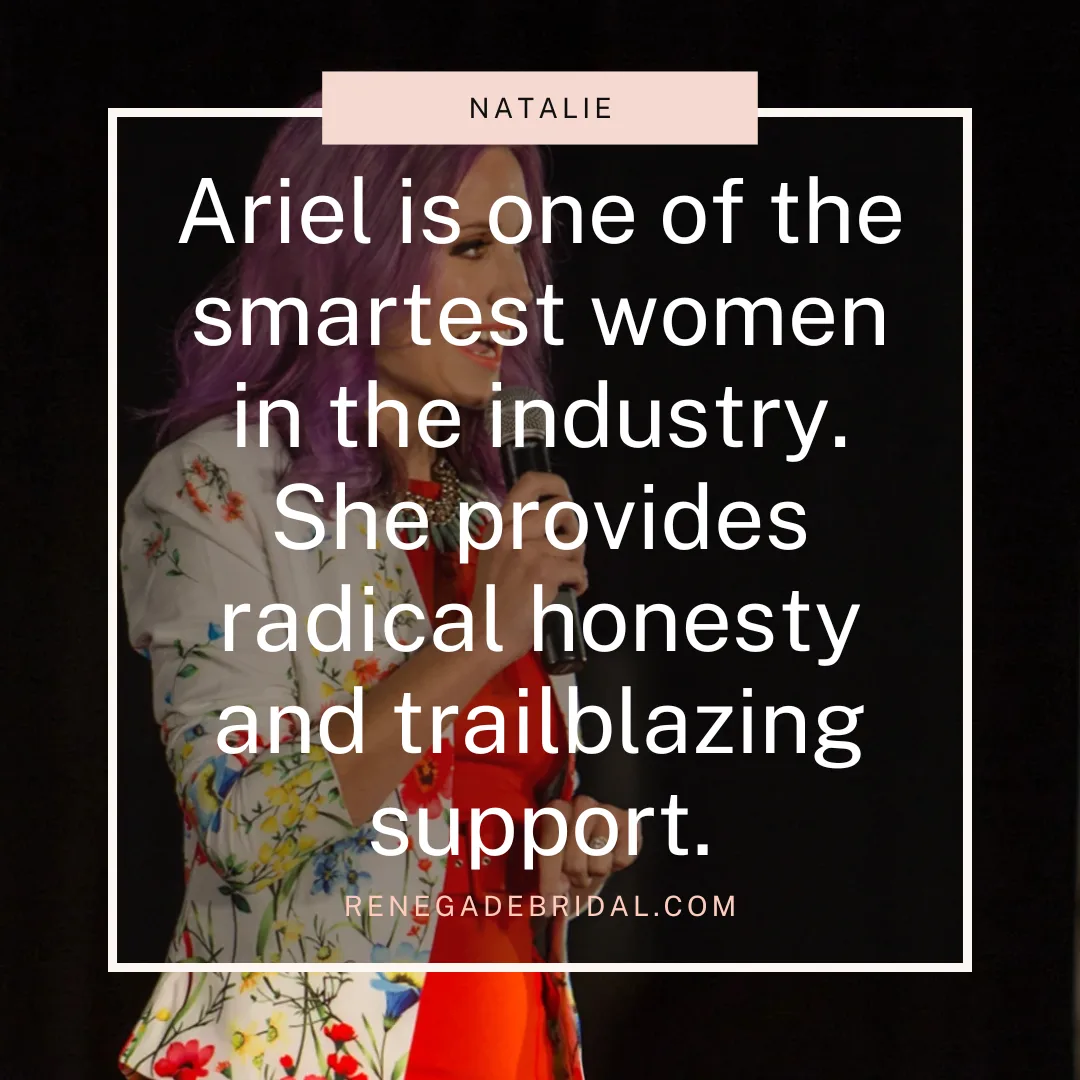
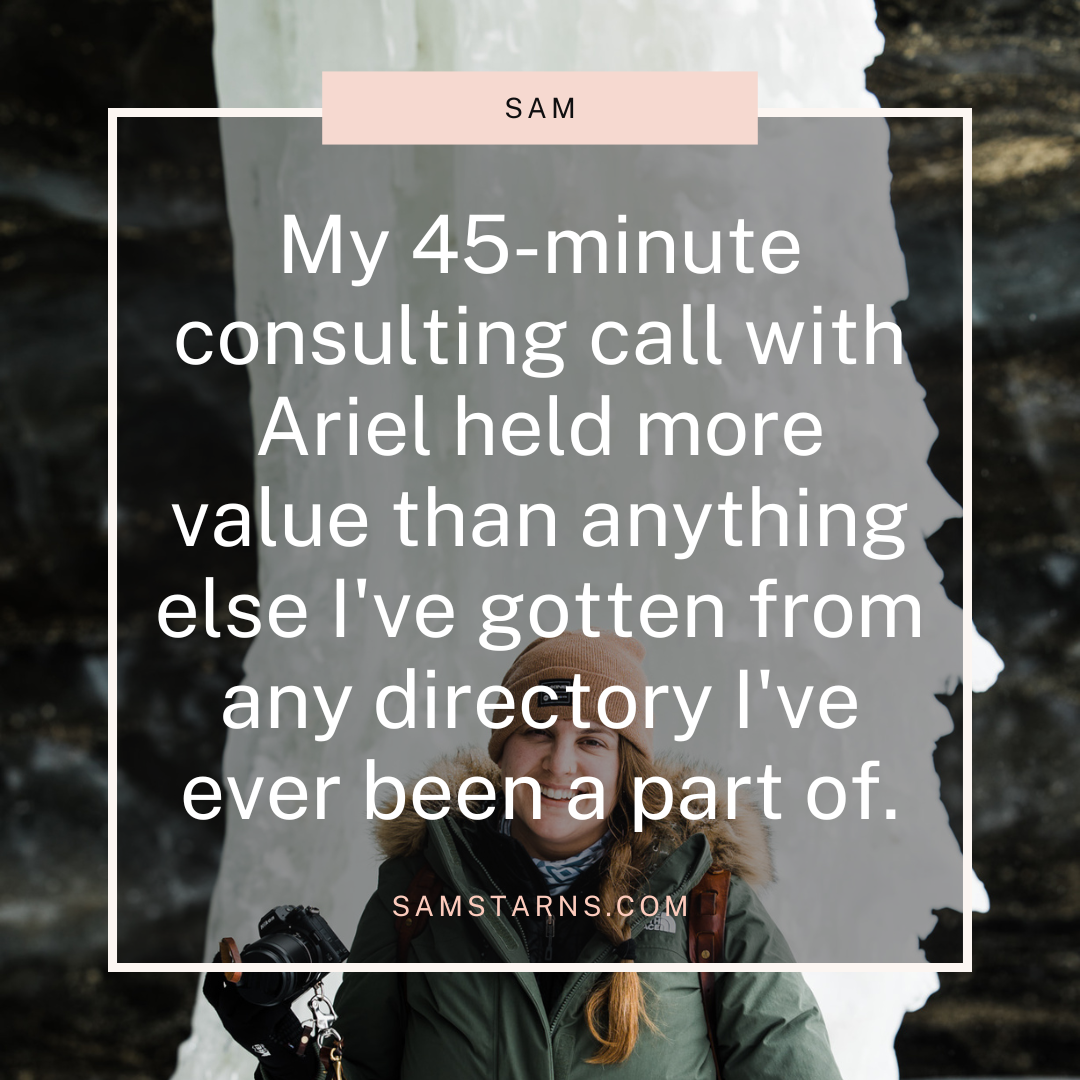
If you want to know more about how my vendor clients feel about our 1:1 calls, I’ll let them speak for themselves:
How to schedule a 1:1 consulting call with me
Every new membership includes at least one 1:1 call with me:
- Consulting + Concierge Tier: You get 1:1 call a year, in addition to your directory listing, the resource library, and I update your listing for you once a year. $900 for the first year, then $700 a year.
- Mentoring + Premiere: You get FOUR 1:1 calls a year, plus premiere placement in the directory, and everything included at the Consulting tier. I cap Mentoring members so I can give each of you real attention. $2200 for the first year, then $2000 a year.
(Note that first-year prices include a $200 onboarding fee.)
If you’d like to sit down and talk through your own business, let’s get you in here.