

Offbeat Wed has been cited in the New York Times as a go-to resource for finding inclusive wedding vendors. We’ve been publishing in this space since 2007, and in nearly two decades of watching how the wedding industry talks to couples, one pattern keeps showing up: vendors who genuinely want to serve a diverse clientele keep accidentally signaling the opposite.
This guide closes that gap.
Who this is for
This guide is for wedding vendors who already give a damn. You’re here because you want to actually do this well, and you’ve realized that wanting to isn’t the same as knowing how.
This is for you if:
- You’re a new vendor and you want to build inclusive practices into your business from the start, rather than spending years undoing assumptions you didn’t know you were making
- You got a queer client or two last season and want to understand how to convert that into a consistent pipeline, rather than a happy accident
- You have a rainbow badge or an inclusion statement on your website and you’re starting to wonder if it’s actually doing anything
- You’ve done styled shoots featuring diverse couples but it felt maybe a little like tokenism
- Your contracts still say “bride” and “groom” and it’s on your list to fix, and as long as you’re doing that you might as well make sure you’re covering all your inclusive bases
- Your diverse clients love working with you but somehow never seem to refer other diverse clients, and you’d like to understand why
- You serve one dimension of diversity well (say LGBTQ+ couples) but aren’t as clear about intersectionality around disability, body size, neurodivergence, or age
- You’re an established vendor who’s been “doing inclusivity” for years and wants to audit whether any of it is actually working
What you get
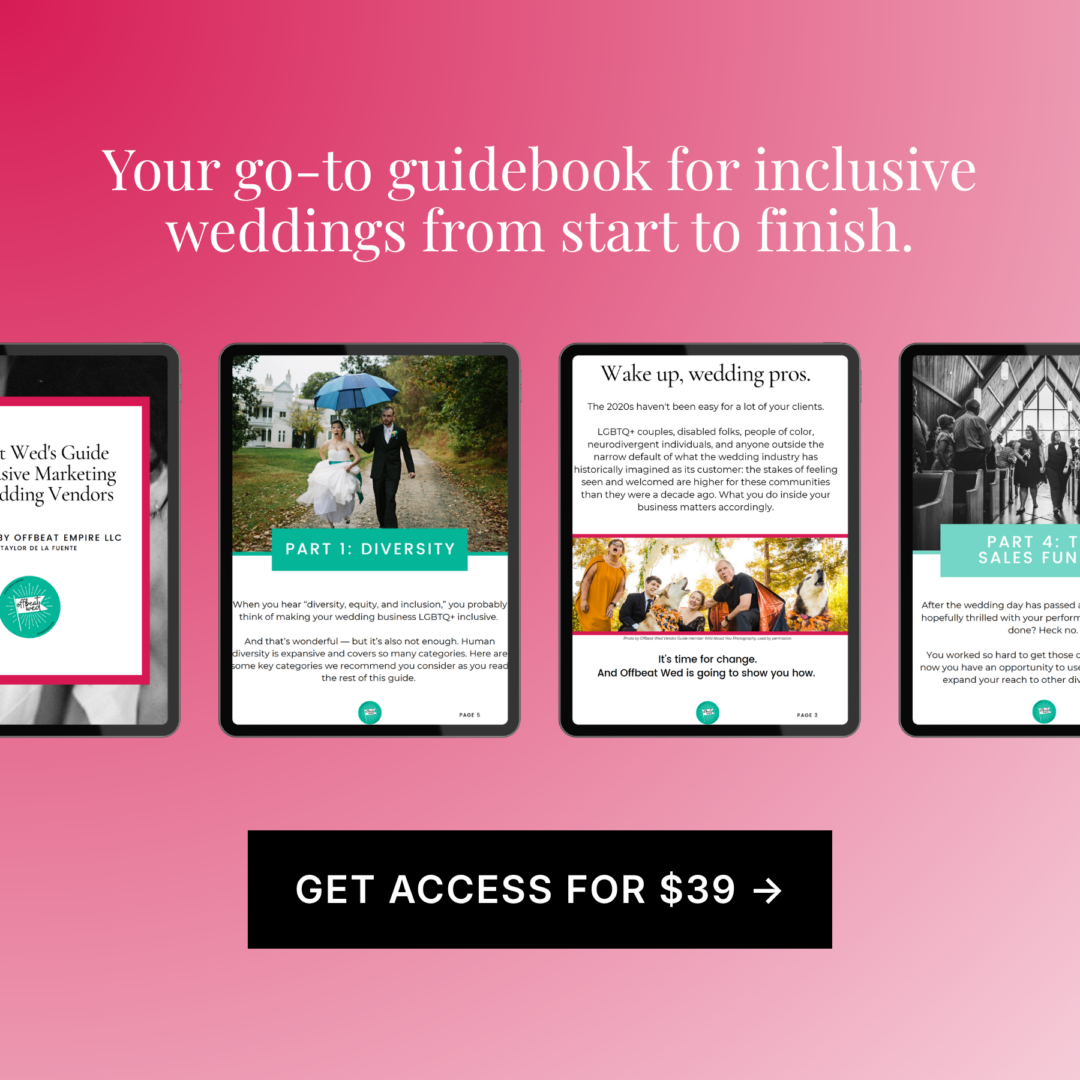
42 pages of specific, non-preachy, industry-grounded guidance covering the entire customer journey, from first impression to post-wedding referral. Topics include:
- Why diversity is broader than you probably think, and what that means for your marketing
- How to audit your marketing copy and imagery for assumptions you didn’t know you were making
- What inclusive language actually looks like in practice, with specific terminology guidance for gender, ethnicity, and relationship structure
- How to choose and source images that reflect the couples you actually want to attract
- Why an inclusion statement or diversity badge on your website can sometimes work against you, and what to do instead
- How to avoid tokenism in styled shoots
- How to make your contracts stop assuming a bride and a groom
- How to ask for reviews and testimonials in a way that builds usable social proof from diverse clients
- How your LGBTQ+ and polyamorous clients are often your most effective referral network, and how to earn that
The business case here is real: Inclusive clients refer inclusive clients. Queer couples talk to their queer friends. Polyamorous clients move in communities where weddings keep happening. When someone feels genuinely seen by a vendor, they say so, and they say it to the people who need to hear it most.
If you serve nontraditional couples, or want to, this is the operational foundation for doing it credibly. This product is included with all Offbeat Wed vendor memberships.
You must log in to submit a review.